
ASEAN in Focus: AI boom driving divergent economic fortunes

28 September 2026
Key takeaways
-
Growth across ASEAN is proving surprisingly resilient in the Year of the Horse…
-
…with the AI hardware boom overpowering the impact of the energy shock.
-
However, look closely, and highly imbalanced growth poses increasing challenges.
Indonesia’s growth remains resilient, supported by investment, manufacturing and services, although weaker external conditions could test confidence. Thailand’s goods imports have spiked in the race to build data centres, pushing the trade balance into deficit. Malaysia is benefiting from the dual tailwinds of the AI wave and higher commodity prices, driving a wider trade surplus. Growth continues to slide while inflation remains high in the Philippines, but a weak peso could improve the economy’s competitiveness. Vietnam grew at the fastest pace in ASEAN in 2Q, backed by robust manufacturing, investment and consumption. Singapore’s growth has been impressive, albeit uneven, with AI and global trade-linked sectors benefiting while domestic consumer-facing sectors remain lukewarm.
Economy profiles
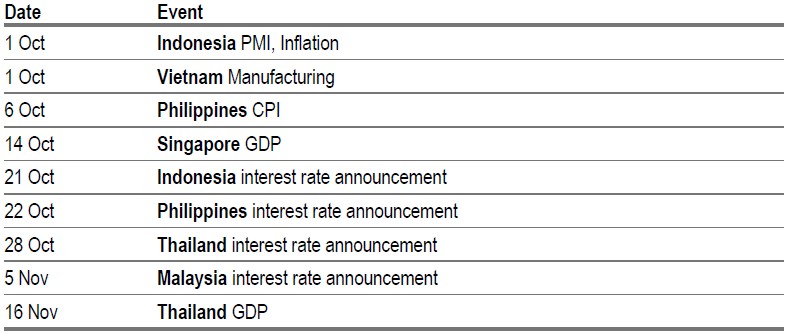
Key upcoming events
Source: LSEG Eikon, HSBC
Indonesia
Some breathing space, but for how long?
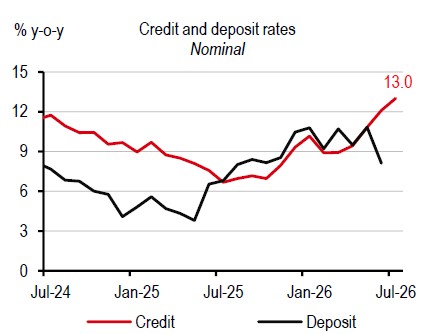
Economic data remains constructive, with growth averaging 5.4% in 1H26 – much higher than expected. Investment is strong, reinforced by a notable pick-up in private sector credit growth. However, consumption has moderated: government spending has slowed and household demand has softened as stimulus effects and festival-related support faded. On the production side, manufacturing has been resilient and services robust. Inflation remains benign and fiscal excesses have been reigned in. The year-to-date fiscal deficit in July was lower than at the same time last year.
All major asset classes – FX, bonds and equities – which lagged Asian peers since the start of the year, showed some signs of a rebound in August. The IDR strengthened against the USD (to c17,700 levels, down from c18,000 a month ago), government bond (SBN) yields fell, and the equity market gradually rebounded.
What’s working in Indonesia’s favour? Hard work and a bit of luck. Bank Indonesia (BI) hiked policy rates by 100bp in May-June. As a result, the interest rate differential versus the US didn’t compress materially and inflows into the debt market rose, albeit modestly. Despite a sudden change in BI leadership, there were some signs of policy continuity. Finally, broader USD weakness worked in the IDR’s favour.
And yet, vulnerabilities remain. One, the trade balance has slipped into deficit from surplus for the first time since 2020. Indonesia, despite being a commodity exporter, has not benefited much from higher commodity prices yet. Meanwhile, imports have risen sharply, led by electronics and machinery – partly reflecting high chip prices. Two, global and other exogenous risks persist. A stronger USD could weigh on the IDR’s recovery (by incentivising outflows). This, along with rising oil prices and strengthening of El Niño conditions in 4Q, could impact the entire economy. Three, the verdict on Indonesia’s emerging market status is still awaited. Recall that MSCI had postponed its annual equity market classification review for Indonesia until November 2026, giving the country extra time to demonstrate meaningful progress on reforms.
With so much going on externally, the need for domestic policy certainty is becoming even more important than before. A recent policy change has been the appointment of a new Finance Minister – Suahasil Nazara. Nazara is an experienced technocrat with several years of experience as the deputy of Sri Mulyani, a known fiscal conservative. As such, it is likely that he continues to stick closely to the 3% fiscal deficit cap.
Credit growth has picked up sharply
Source: CEIC, HSBC
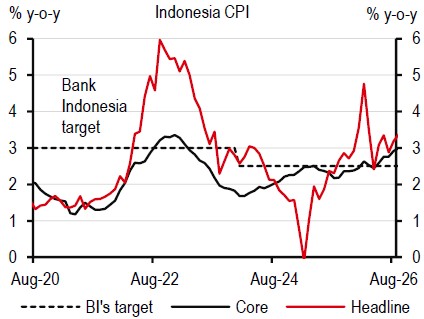
Inflation has remained close to BI’s target range of 1.5-3.5%
Source: CEIC, HSBC
Malaysia
ASEAN’s silver medallist, likely for the second year
Despite facing an energy shock and ongoing tariff developments, growth in many trade-dependent economies has defied these headwinds. In fact, we have even seen growth accelerate in some economies in 2Q26 in ASEAN. This is certainly the case in Malaysia.
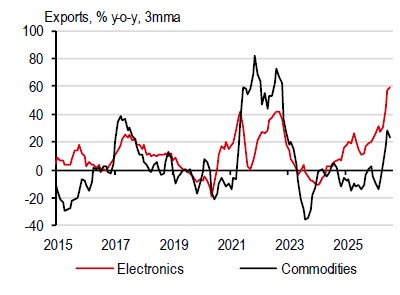
Malaysia’s GDP growth momentum accelerated to 2.5% q-o-q (seasonally adjusted) in 2Q, bringing y-o-y growth to the 6% club, thanks to booming trade. After all, Malaysia is Asia’s only dual beneficiary of both the AI wave and high commodity prices. It is not only one of Asia’s three net energy exporters but also on the frontline to benefit from the AI cycle, given its extensive tech manufacturing supply chain. On a three-month moving average basis (3mma), Malaysia’s electronics momentum jumped 60%, a trend we also observed in Singapore and Vietnam, while commodity momentum also rose over 20%.
It is not only electronics exports: the trade balance also matters. Singapore and Malaysia are the only two economies in ASEAN that have seen wider trade surpluses, unlike Thailand and Vietnam, which have seen consistent trade deficits, despite rising electronics exports. Malaysia’s average trade surplus in electrical machinery and electronics (E&E) products saw a 64% y-o-y rise so far this year versus its 2025 average, already exceeding its historic high in 2022 when there was a global shortage of auto chips.
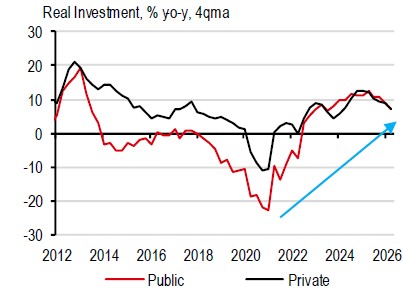
That said, Malaysia’s strength is not limited to trade – it is more broad-based with decent domestic demand. For one, private consumption remains the backbone of growth, expanding just a tad below 5% y-o-y. The labour market remains healthy, with the unemployment rate at 3% and wages picking up. Elsewhere, public and private investment remained strong, though both have continued to moderate from double-digit to single-digit growth.
Overall, we forecast Malaysia’s 2026 GDP growth at 5.2%, which means that the country could be ASEAN’s second fastest-growing economy for the second consecutive year. Given the AI boom, we recently upgraded Malaysia’s 2027 GDP to 5% (from 4.7%). We believe that Malaysia has a solid story, both structurally and cyclically.
Outside of growth, inflation has been benign. Headline inflation rose by only 1.8% y-o-y, with core inflation hovering around 2% y-o-y in the first seven months of 2026. This is largely thanks to Malaysia’s generous subsidies, with the petrol RON95 price remaining at MYR1.99/l with a monthly quota of 300l and the diesel price at MYR2.10/l with a monthly cap of 400l. Overall, we recently trimmed our inflation forecasts to 1.9% (from 2.5%) for 2026 and to 2.3% (from 2.7%) for 2027.
Malaysia is a dual beneficiary of the AI boom and high commodity prices
Source: CEIC, HSBC
Still strong, but both private and public investment growth moderated
Source: CEIC, HSBC
Philippines
Aftershocks
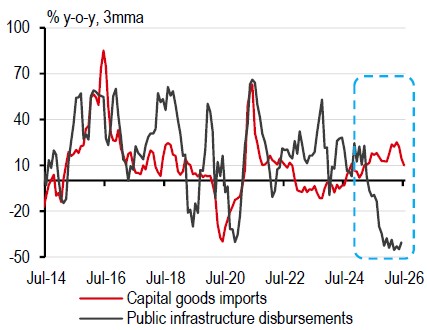
Growth continues to slide while inflation remains too high. GDP has surprised to the downside for the fourth consecutive quarter, with growth slowing to 2.3% y-o-y in 2Q26, the slowest since 2009, barring the COVID-19 pandemic. The aftershocks of last year’s public infrastructure fallout continue to reverberate throughout the economy. Unemployment has risen in line with less demand for construction. Therefore, households have trodden with caution; private consumption has tumbled to well below potential, growing by just 2.9% y-o-y in 2026 year-to-date.
Meanwhile, the trade deficit has widened back to levels last seen during the 2022 oil shock. Of course, pricey fuel imports are partly to blame. But demand for supercomputers and high-tech hardware – items the economy needs to import – has also been strong, with the economy joining the global data centre bandwagon. Therefore, despite weaker demand for cement, steel, and drilling equipment, capital imports continue to surge. Electronic machinery imports have risen 43% y-o-y, year-to-date – that’s a lot of computers.
This has stoked concerns about the balance of payments. The economy is well known for being a consumption powerhouse. However, with consumption stumbling as of late, business and consumer sentiment has remained downbeat. Externally, FDI continues to dip while hot money continues to flow out. Consequently, the PHP hit a record low against the USD multiple times in September, keeping the Bangko Sentral ng Pilipinas (BSP) walking at the tip of its toes.
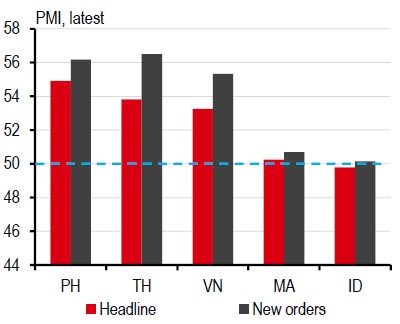
However, there is a silver lining: a weak PHP − provided the depreciation is orderly − can help lift the economy’s competitiveness amid the AI tech upcycle. Real goods exports in 2Q26 jumped 17% y-o-y, and leading indicators look robust. Not only did the Philippines post the highest PMI in ASEAN in August, but it was also the highest reading since end-2016. Exports roared after that reading; in 2017, goods and services exports grew 17.4% for the year in real terms.
Looking ahead, growth in 2027 is likely to improve to 4.8%. The fading base effects of the public infrastructure fallout alone, should, lift growth. Growth in 2028 should then continue to improve as the election season boosts overall demand. We expect growth in 2028 to rise to 5.4%. Nevertheless, without fiscal policy operating at full throttle, GDP is likely to remain below the economy’s potential, even if manufacturing and exports perform better than before.
Public infrastructure spending continues to fall, but capital imports continue to rise
Source: CEIC, HSBC
A competitive PHP should eventually be supportive of exports and manufacturing
Source: S&P, HSBC
Singapore
AI-powered outperformer
When the Middle East conflict broke out early this year, ASEAN was widely viewed as one of the most affected regions. However, it is important to remember that ASEAN is diverse. Despite the conflict, two economies stand out for their relative resilience: Malaysia and Singapore. The former’s performance was broadly expected as it is one of only three net energy exporters in Asia. The latter’s economic resilience was less widely anticipated, given its heavy reliance on imports.
Despite being a developed market, Singapore has been growing at rates more typical of an emerging market. Singapore’s economy expanded by more than 6% y-o-y in the first half of 2026, making it the second-fastest growing economy in ASEAN, just after Vietnam’s 8%-plus growth.Beyond the strong y-o-y print, growth momentum was also strong.
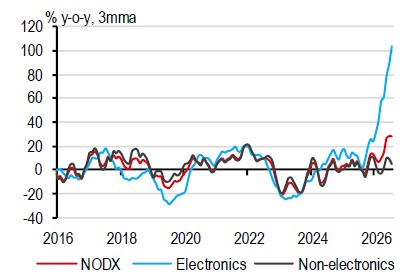
While manufacturing momentum declined in 1Q, it was more of a healthy pull-down from previously sustained manufacturing strength. Industrial production (IP) saw a strong rebound of over 6% q-o-q (seasonally adjusted) in 3Q, reflecting the continued strength in the AI-fuelled tech boom. This is also reflected in high frequency indicators, pointing to an exceptionally strong electronics trade. On a three-month moving average basis, electronics non-oil domestic exports (NODX) accelerated by over 100% y-o-y in July.
Despite impressive growth, Singapore’s growth was rather uneven. The sectors that are closely linked to AI and global trade, such as advanced manufacturing and wholesale services, have benefitted handsomely from this upturn. However, domestic consumer-facing sectors like retail sales and ‘food and beverage’ services continue to see lukewarm performances.
However, overall, we are ever more convinced of sustained strong growth in Singapore. We recently upgraded our growth forecasts to 5.1% (from 4.6%) for 2026 and to 3.3% (from 2.5%) for 2027.
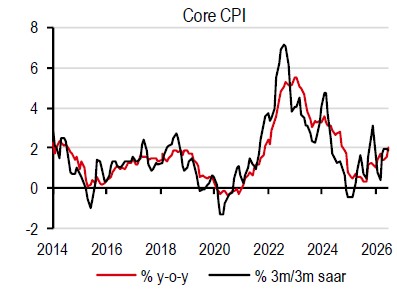
Meanwhile, inflation pressures have started to kick in. Partially, this is related to the lagged effect of the electricity price hike on core inflation. Based on the Energy Market Authority’s data, the electricity tariff has increased by over 7% q-o-q alone in 3Q, lifting core inflation to 2% y-o-y. We expect inflation to stay above 2% y-o-y from 3Q26 and likely to fall below 2% only in 4Q27. Overall, we tweaked our core inflation forecast slightly to 1.8% (from 2%) for 2026 but kept it at 2.2% for 2027. We do not think the Monetary Authority of Singapore (MAS) has completed its hiking cycle.
Semiconductor non-oil domestic exports (NODX) surged in 2026
Source: CEIC, HSBC
Inflation jumped to 2% y-o-y in July though the momentum remained steady
Source: CEIC, HSBC
Thailand
The search for computing power
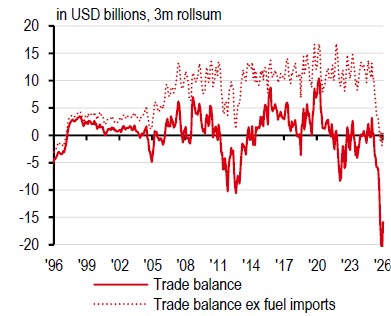
Let’s put aside oil and the Strait of Hormuz for a moment, and we notice numbers that we haven’t seen in Thailand in decades. For instance, goods imports have been exceptionally strong, whereby Thailand’s current account deficit in 2Q26 widened to as much as 12% of GDP. Even if we remove oil, Thailand’s trade balance would still be in deficit – a first since 1998.
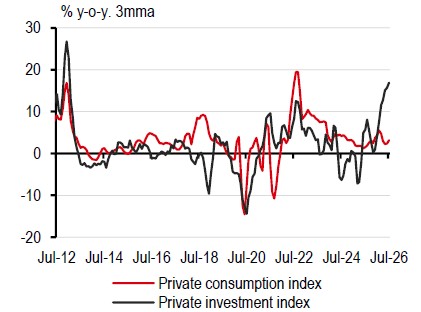
This is all because of Thailand’s search for computing power. Ever since the February 2026 election, the investment floodgates have opened. Private investment in Thailand has been growing at c16% y-o-y, the fastest since 2013, as a swathe of data centres is being built across the economy. This has led to an ‘AI deficit’, whereby demand for high-end electronic machinery – hardware that Thailand does not produce – is outpacing export demand, even amidst an AI tech upcycle. And mind you, goods exports have already risen 14.8% y-o-y year-to-date.
Despite punchy capital spending and exports, growth remained subdued at 1.9% y-o-y in 2Q26. Higher oil prices were partly to blame. However, it is also important to consider how concentrated the benefits of the AI tech upcycle are. According to a study by the Bank of Thailand (BoT), 1% of tech exporters have a significant market share of 85% of Thailand’s tech exports, with most being foreign firms. In addition, data centres are highly dependent on capital imports, such as those hightech components you get from Taiwan or South Korea. The domestic value-added of data centre investments is, simply, limited: they don’t create higher wages nor more jobs. As a result, private consumption has remained subdued and has been left behind by private investment.
Regardless, we expect growth to accelerate in 3Q26. The ongoing fiscal stimulus called the ‘Thai Help Thai Plus’ should lift consumption, especially given its size (c2% of GDP). After that, fiscal policy is likely to ease. The fiscal year 2027 budget is only 0.2% higher than the previous year’s budget to ensure that the public debt-to-GDP ratio remains within the country’s self-imposed limit of 70% (Reuters, 23 June 2026).
Investment and exports are likely to continue to push ahead. However, limited spillover to the general economy means they are unlikely to offset the drag caused by softer fiscal policy. We expect growth to slow to 1.6% in 2027. However, 2028 should be a better year. Once these data centre investments come online, Thailand is likely to unlock a new growth driver for the economy: computer services. Just look at Malaysia. We expect the growth outlook to improve in 2028, whereby we pencil in a full-year growth rate of 2.6%.
Private investment is surging while private consumption remains relatively subdued
Source: Macrobond, HSBC
Demand for data centres has led to a sharp deterioration in the trade balance
Source: CEIC, HSBC
Vietnam
The new normal
Unlike some peers whose economies have been hit hard, Vietnam has proved to investors that its economy has more than just survived the oil shock – it has thrived. Defying the energy shock, Vietnam saw GDP growth accelerate to 8.4% y-o-y in 2Q, easily sustaining its position as one of Asia’s fastest-growing economies.
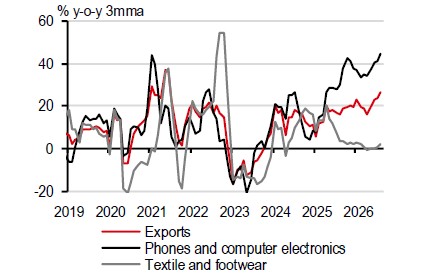
The manufacturing sector expanded briskly. This is also reflected in Vietnam’s impressive trade performance. Export growth accelerated to over 20% y-o-y in the first eight months of 2026, driven by the boom in electronics shipments – a similar trend seen in other tech-exposed Asian economies. While its electronics products are still concentrated in low-value products, the existing tech cluster and promising talent pool put Vietnam in an advantageous position when competing with ASEAN peers to further climb up the value chain.
In addition to trade, strong growth was broad-based. What was surprising was the significant jump in real investment in 2Q, essentially growing by over 20% y-o-y in one single quarter to lift investment growth YTD to 15%. Although no detailed breakdown is available, we believe the investment boom is driven by ongoing strength in the foreign direct investment (FDI) inflows and an accelerated push for mega infrastructure projects.
Meanwhile, consumption remains decent, despite high energy prices. Private consumption growth remained steady at around 8% y-o-y in 2Q, partly thanks to an improving labour market and the tourism boost. Vietnam retains the crown in ASEAN for the highest recovery rate of tourists relative to pre-pandemic levels. It is the only regional economy that saw tourists exceeding 2019’s level, not to mention by a margin of 40%. Vietnam has welcomed over 15 million tourists YTD, paving the way to achieve its annual target of attracting 25 million international visitors.
Overall, we forecast GDP growth of 8.2% for 2026 and 8.0% for 2027. We remain constructive on Vietnam’s structural fundamentals.
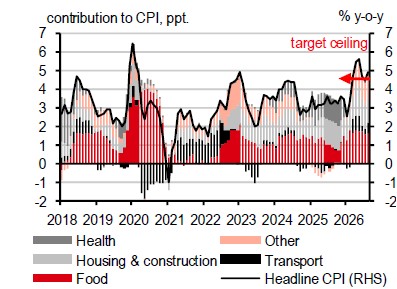
In addition, inflation remains remarkably sensitive to global commodity price swings. While it cooled in June and July, headline inflation rebounded to reach almost 5% y-o-y in August, due to rising oil prices. We maintain our 2026 inflation forecast at 4.5%, which is the State Bank of Vietnam’s (SBV) ceiling, but we revised up our 2027 forecast to 3.5% (from 3.3%). However, risks remain to the upside, given elevated energy prices.
Vietnam’s export boom is largely driven by strong growth in consumer electronics
Source: CEIC, HSBC
Headline inflation exceeded the SBV’s 4.5% ceiling again in August
Source: CEIC, HSBC


Achieve your wealth goals with our suite of wealth management solutions

Open an investment account and start your wealth journey with us
Related Insights


Disclosure appendix
Important disclosures
This document is for information purposes only and it should not be regarded as an offer to sell or as a solicitation of an offer to buy the securities or other investment products mentioned in it and/or to participate in any trading strategy. Information in this document is general and should not be construed as personal advice, given it has been prepared without taking account of the objectives, financial situation or needs of any particular investor. Accordingly, investors should, before acting on it, consider the appropriateness of the information, having regard to their objectives, financial situation and needs. If necessary, seek professional investment and tax advice.
Certain investment products mentioned in this document may not be eligible for sale in some states or countries, and they may not be suitable for all types of investors. Investors should consult with their HSBC representative regarding the suitability of the investment products mentioned in this document and take into account their specific investment objectives, financial situation or particular needs before making a commitment to purchase investment products.
The value of and the income produced by the investment products mentioned in this document may fluctuate, so that an investor may get back less than originally invested. Certain high-volatility investments can be subject to sudden and large falls in value that could equal or exceed the amount invested. Value and income from investment products may be adversely affected by exchange rates, interest rates, or other factors. Past performance of a particular investment product is not indicative of future results.
HSBC and its affiliates will from time to time sell to and buy from customers the securities/instruments (including derivatives) of companies covered in HSBC Research on a principal or agency basis.
Whether, or in what time frame, an update of this analysis will be published is not determined in advance.
HSBC may use Artificial Intelligence (AI) tools approved for adoption within HSBC in the development of its research reports, utilizing these technologies to analyse large volumes of data, enhance efficiency and improve the overall user experience. This includes but is not limited to paraphrasing, developing suitable captions and supporting data visualisation. It is important to note that while AI tools assist in various aspects of report creation, all investment recommendations and opinions presented herein are formulated and approved exclusively by our research analysts. The final content of the report reflects the professional judgement and expertise of our research analysts, ensuring compliance with regulatory standards and maintaining the integrity of our research process.
Additional disclosures
1. This report is dated as at 25 September 2026.
2. All market data included in this report are dated as at close 24 September 2026, unless a different date and/or a specific time of day is indicated in the report.
3. HSBC has procedures in place to identify and manage any potential conflicts of interest that arise in connection with its Research business. HSBC's analysts and its other staff who are involved in the preparation and dissemination of Research operate and have a management reporting line independent of HSBC's Investment Banking business. Information Barrier procedures are in place between the Investment Banking, Principal Trading, and Research businesses to ensure that any confidential and/or price sensitive information is handled in an appropriate manner.
4. You are not permitted to use, for reference, any data in this document for the purpose of (i) determining the interest payable, or other sums due, under loan agreements or under other financial contracts or instruments, (ii) determining the price at which a financial instrument may be bought or sold or traded or redeemed, or the value of a financial instrument, and/or (iii) measuring the performance of a financial instrument or of an investment fund.
Disclaimer
This document is prepared by The Hongkong and Shanghai Banking Corporation Limited (‘HBAP’), 1 Queen’s Road Central, Hong Kong. HBAP is incorporated in Hong Kong and is part of the HSBC Group. This document is distributed by HSBC Continental Europe, HBAP, HSBC Bank (Singapore) Limited, HSBC Bank (Taiwan) Limited, HSBC Bank Malaysia Berhad (198401015221 (127776- V))/HSBC Amanah Malaysia Berhad (200801006421 (807705-X)), The Hongkong and Shanghai Banking Corporation Limited, India (HSBC India), HSBC Bank Middle East Limited, HSBC UK Bank plc, HSBC Bank plc, Jersey Branch, and HSBC Bank plc, Guernsey Branch, HSBC Private Bank (Suisse) SA, HSBC Private Bank (Suisse) SA DIFC Branch, , HSBC Financial Services (Lebanon) SAL, HSBC Private banking (Luxembourg) SA, and The Hongkong and Shanghai Banking Corporation Limited (collectively, the “Distributors”) to their respective clients. This document is for general circulation and information purposes only. This document is not prepared with any particular customers or purposes in mind and does not take into account any investment objectives, financial situation or personal circumstances or needs of any particular customer. HBAP has prepared this document based on publicly available information at the time of preparation from sources it believes to be reliable but it has not independently verified such information. The contents of this document are subject to change without notice. HBAP and the Distributors are not responsible for any loss, damage or other consequences of any kind that you may incur or suffer as a result of, arising from or relating to your use of or reliance on this document. HBAP and the Distributors give no guarantee, representation or warranty as to the accuracy, timeliness or completeness of this document. This document is not investment advice or recommendation nor is it intended to sell investments or services or solicit purchases or subscriptions for them. You should not use or rely on this document in making any investment decision. HBAP and the Distributors are not responsible for such use or reliance by you. You should consult your professional advisor in your jurisdiction if you have any questions regarding the contents of this document. You should not reproduce or further distribute the contents of this document to any person or entity, whether in whole or in part, for any purpose. This document may not be distributed to any jurisdiction where its distribution is unlawful.
The following statement is only applicable to HSBC Bank (Taiwan) Limited with regard to how the publication is distributed to its customers: HSBC Bank (Taiwan) Limited (“the Bank”) shall fulfill the fiduciary duty act as a reasonable person once in exercising offering/conducting ordinary care in offering trust services/business. However, the Bank disclaims any guaranty on the management or operation performance of the trust business.
The following statement is only applicable to by HSBC Bank Australia with regard to how the publication is distributed to its customers: This document is distributed by HSBC Bank Australia Limited ABN 48 006 434 162, AFSL/ACL 232595 (HBAU). HBAP has a Sydney Branch ARBN 117 925 970 AFSL 301737.The statements contained in this document are general in nature and do not constitute investment research or a recommendation, or a statement of opinion (financial product advice) to buy or sell investments. This document has not taken into account your personal objectives, financial situation and needs. Because of that, before acting on the document you should consider its appropriateness to you, with regard to your objectives, financial situation, and needs.
Important Information about the Hongkong and Shanghai Banking Corporation Limited, India (“HSBC India”)
HSBC India is a branch of The Hongkong and Shanghai Banking Corporation Limited. HSBC India does not distribute or refer investment products to those persons who are either the citizens or residents of United States of America (USA), Canada or any other jurisdiction where such distribution or referral would be contrary to law or regulation. HSBC India is an AMFI-registered Mutual Fund Distributor and an AMFI-registered Specialized Investment Fund (SIF) Distributor. HSBC India distributes select mutual fund schemes and SIF strategies of empanelled Asset Management Companies, and acts as a referrer of other third-party investment products.
Mutual Fund investments are subject to market risks, read all scheme-related documents carefully
AMFI-registered Mutual Fund Distributor | Date of Initial Registration: 19th Feb-2002 | ARN-0022 I Validity of ARN: 18th Feb- 2027
AMFI-registered SIF Distributor I Date of initial registration: 27th Oct 2025 | ARN-0022 I Validity of ARN : 26th Oct 2028
HSBC India will receive commission from HSBC Asset Management (India) Private Limited, in its capacity as a AMFI registered mutual fund distributor of HSBC Mutual Fund. The Sponsor of HSBC Mutual Fund is HSBC Securities and Capital Markets (India) Private Limited (HSCI), a member of the HSBC Group. Please note that HSBC India and the Sponsor being part of the HSBC Group, may give rise to real, perceived, or potential conflicts of interest. HSBC India has a policy in place to identify, prevent and manage such conflict of interest
For more information related to investments in the securities market, please visit the SEBI Investor Website: https://investor.sebi.gov.in/ and the SEBI Saa₹thi Mobile App. Mutual Fund investments are subject to market risks, read all scheme related documents carefully.
Issued by The Hongkong and Shanghai Banking Corporation Limited India . Incorporated in Hong Kong SAR with limited liability.
Singapore
In Singapore, this document:
• has not been reviewed by any regulatory authority in Singapore or any other jurisdiction.
• is issued by HSBC Bank (Singapore) Limited (the "Bank") in the conduct of its business in Singapore and is for general information.
• is only meant for the person who received it and should not be copied or shared with others, either fully or partially, for any reason.
• must not be sent to the United States, Canada or Australia or to any other jurisdiction where sharing it is illegal. If someone uses or copies this document or video without permission, they could face legal action.
• gives a broad overview of the current economic environment and is not meant to be investment research or advice or a recommendation to buy or sell investments. Some parts might talk about future events, but these are just predictions and not promises nor guarantees of future performance or events. Actual results might turn out differently due to various reasons. The Bank is not responsible for updating these predictions or explaining why actual results could differ from those predictions.
• does not create any contracts and isn’t meant as a solicitation, nor a recommendation for the purchase or sale of any financial instrument in any jurisdiction where it is not legal. Investments can increase or decrease in value, and you might not get back the amount you initially invested. Investments come with market risks, so it is important to read all investment-related documents carefully. The opinions shared are from the HSBC Global Investment Committee at the time of creating this document or video and reflect its global perspective, which might differ from local views of the Bank. These opinions can change anytime and might not match HSBC Asset Management‘s current portfolios’ composition. HSBC Asset Management manages individual portfolios based on each client’s objectives, risk preferences, time horizon, and market conditions.
• has not been created following legal requirements for independent investment research and is not subject to any prohibition on dealing ahead of its dissemination.
• is not meant to offer accounting, legal or tax advice. Before making any investment decision, consider consulting a financial adviser. If you decide not to seek advice, carefully assess if the investment product is suitable for you. It is recommended to obtain appropriate professional advice when needed.
Investing overseas can lead to changes in the value of your investments due to currency exchange rates, which may cause them to rise or fall. Emerging markets are riskier and more unpredictable compared to established markets. These economies often depend heavily on international trade and can be adversely impacted by trade barriers, currency controls, adjustments in currency values, the economic conditions of their trading partners and other protective measures imposed by those partners.
We are not responsible for the accuracy and/or completeness of any third-party information obtained from sources we believe to be reliable but have not independently verified.
Mainland China
In mainland China, this document is distributed by HSBC Bank (China) Company Limited (“HBCN”) to its customers for general reference only. This document is not, and is not intended to be, for the purpose of providing securities and futures investment advisory services or financial information services, or promoting or selling any wealth management product. This document provides all content and information solely on an "as-is/as-available" basis. You SHOULD consult your own professional adviser if you have any questions regarding this document.
The material contained in this document is for general information purposes only and does not constitute investment research or advice or a recommendation to buy or sell investments. Some of the statements contained in this document may be considered forward looking statements which provide current expectations or forecasts of future events. Such forward looking statements are not guarantees of future performance or events and involve risks and uncertainties. Actual results may differ materially from those described in such forward-looking statements as a result of various factors. HSBC India does not undertake any obligation to update the forward-looking statements contained herein, or to update the reasons why actual results could differ from those projected in the forward-looking statements. Investments are subject to market risk, read all investment related documents carefully.
Should you wish to use AI technology (computational, statistical, machine-learning or other artificial intelligence techniques to infer or learn from data to find patterns, take actions, make decisions, or generate output) to help you analyse, summarise or evaluate this publication and/or any other research materials provided to you by HSBC, you shall seek HSBC consent in advance of any such use and not upload this publication and/or any other research materials produced by HSBC to an AI system or otherwise use AI technology in connection with the research services HSBC provides to you without our consent.
© Copyright 2026. The Hongkong and Shanghai Banking Corporation Limited, ALL RIGHTS RESERVED. No part of this document may be reproduced, stored in a retrieval system, or transmitted, on any form or by any means, electronic, mechanical, photocopying, recording or otherwise, without the prior written permission of The Hongkong and Shanghai Banking Corporation Limited.
Important information on sustainable investing
“Sustainable investments” include investment approaches or instruments which consider environmental, social, governance and/or other sustainability factors (collectively, “sustainability”) to varying degrees. Certain instruments we include within this category may be in the process of changing to deliver sustainability outcomes.
There is no guarantee that sustainable investments will produce returns similar to those which don’t consider these factors. Sustainable investments may diverge from traditional market benchmarks. In addition, there is no standard definition of, or measurement criteria for sustainable investments, or the impact of sustainable investments (“sustainability impact”). Sustainable investment and sustainability impact measurement criteria are (a) highly subjective and (b) may vary significantly across and within sectors.
HSBC may rely on measurement criteria devised and/or reported by third party providers or issuers. HSBC does not always conduct its own specific due diligence in relation to measurement criteria. There is no guarantee: (a) that the nature of the sustainability impact or measurement criteria of an investment will be aligned with any particular investor’s sustainability goals; or (b) that the stated level or target level of sustainability impact will be achieved.
Sustainable investing is an evolving area and new regulations may come into effect which may affect how an investment is categorised or labelled. An investment which is considered to fulfil sustainable criteria today may not meet those criteria at some point in the future.